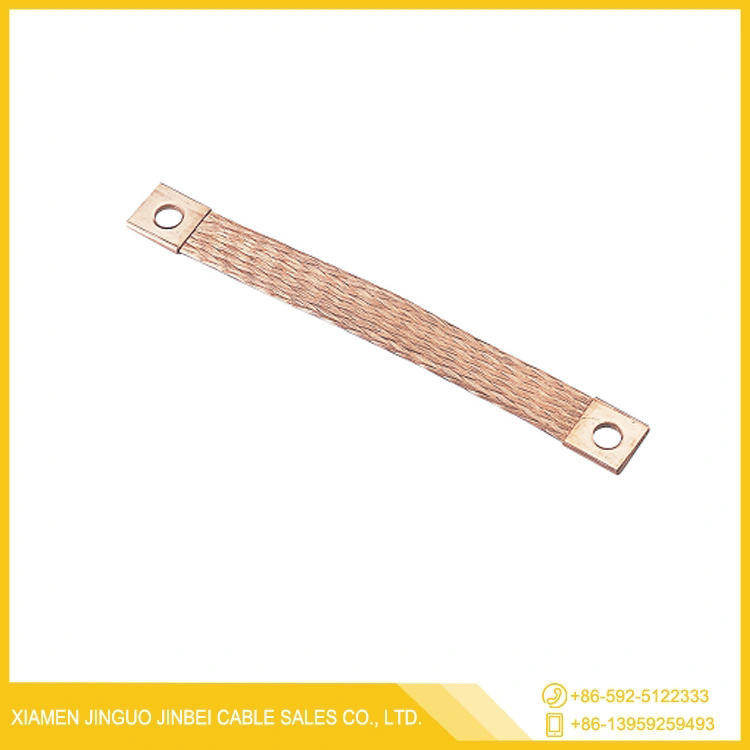
As global energy transition accelerates and electrical equipment moves toward higher power density, Copper Laminated Flexible Connectors and Copper Laminated Flexible Jumpers are gradually replacing rigid connection solutions due to their superior conductivity, vibration resistance, fatigue resistance, and structural flexibility—making them the focal point of industry discussions.
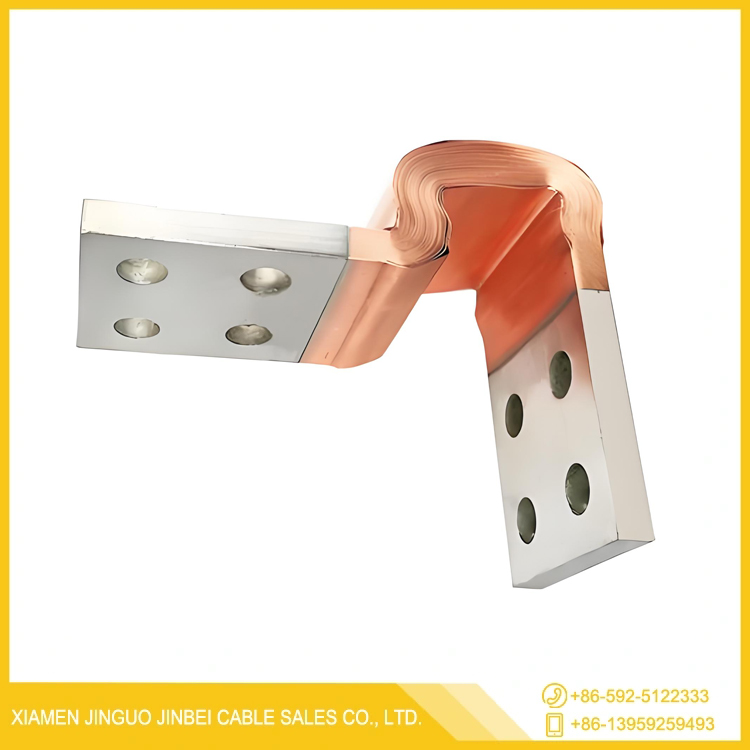
The technical essence of the core products discussed here—Copper Laminated Flexible Connectors and their derivative Jumpers—lies in optimizing traditional cable or rigid busbar connection methods.
Typical Technical Specifications:
| Parameter | Value Range |
|---|---|
| Copper Purity | ≥99.95% |
| Single Foil Thickness | 0.05mm – 0.50mm |
| Total Connector Thickness | 2mm – 50mm (customizable) |
| Current Carrying Capacity | 100A – 10,000A+ |
| Operating Temperature | -40°C to +280°C |
| Electrical Resistivity | ≤0.017241 Ω·mm²/m (annealed copper standard) |
| Dielectric Strength | Up to 3,000V (depending on insulation) |
| Minimum Bending Radius | 5× thickness |
| Vibration Resistance | Meets IEC 60068-2-6 standard |
In vibration-prone environments such as new energy battery packs, high-power inverters, and rail transit, traditional rigid connections are prone to fracture or increased contact resistance. Modern laminated copper flexible connectors, manufactured using multi-layer high-purity copper foils through molecular diffusion welding technology, achieve tensile strength in the welded zone exceeding 90% of the base material.
Copper Flexible Belts can be customized according to customer requirements:
Length range: 50mm to 5,000mm
Termination finishes: Bare copper, Tin-plated, Nickel-plated, Silver-plated
Insulation jacketing: PVC, Silicone rubber, Heat shrink tubing, Nomex® aramid paper
Hole specifications: Round, square, slotted; M4 to M20 diameters
Braids: Cross-section 4mm² – 1,200mm², suitable for high-flexibility, high-frequency vibration environments
Laminates: Cross-section 10mm² – 2,500mm², suitable for high-current, low-impedance applications
With the widespread adoption of 800V high-voltage platforms in electric vehicles and energy storage systems, higher demands are placed on connectors regarding voltage withstand capability, current-carrying capacity, and electrochemical corrosion resistance. Copper Laminated Flexible Jumpers, with their low impedance (typical value <0.1mΩ/m) and high current-carrying characteristics, have become the preferred solution for connecting battery modules, inverters, and motor controllers.
They ensure stable power transmission under high-frequency switching and thermal cycling, minimizing voltage drops and energy losses. Their flexible design accommodates mechanical vibrations and assembly tolerances without compromising electrical integrity. Moreover, the copper lamination structure enhances fatigue resistance compared to traditional flat cables, extending service life in demanding EV and renewable energy applications.